Meet Bubble: The Rescue Dog Turned Trail Athlete
This is a throwback article written by trail runner Shona Stephenson for Trail Run Magazine issue 14 in 2014.
Words: Shona Stephenson
Images: Michael Leadbetter
Shona Stephenson shares how her rescued Kelpie, Bubble, became her loyal training partner, offering safety, motivation and endless energy on long, remote runs. Shona explains that through patience, training and care, Bubble transformed from an underweight stray into a strong, reliable running machine — proving dogs can be incredible trail companions (see tips and cautions below before taking a dog running).
They pant and dribble more than you, often smell worse, and you have to be very aware of when they need to go to the toilet. On the upside, they don’t complain about the distance or the choice of route, they have boundless energy and just when you hit the wall, they pick you back up again with some kind of goofy ‘gimme more’ look that sparks the spirit back into running action. Yes, trail running with your best friend is good for you, especially when they have four legs. A regular on trails with her dog Bubble, Shona Stephenson, talks to Trail Run Magazine about how she became a hound harrier.
Ultra trail running can be lonely
Especially the long and remote runs, which are often part of my training routine. Sometimes I dread heading out with no one to speak to for 30, 50 or 60 kilometres, while I rack up the distance required for milers. I’ve also had a few real concerns for my safety while training.
My solution
Bubble. Yes, Bubble, capital ‘B’: my dog, an Australian Black Kelpie. To be honest, when I run with Bubble, it’s less a matter of safety and more about simply having a companion who gets as eager for the trail as I do.
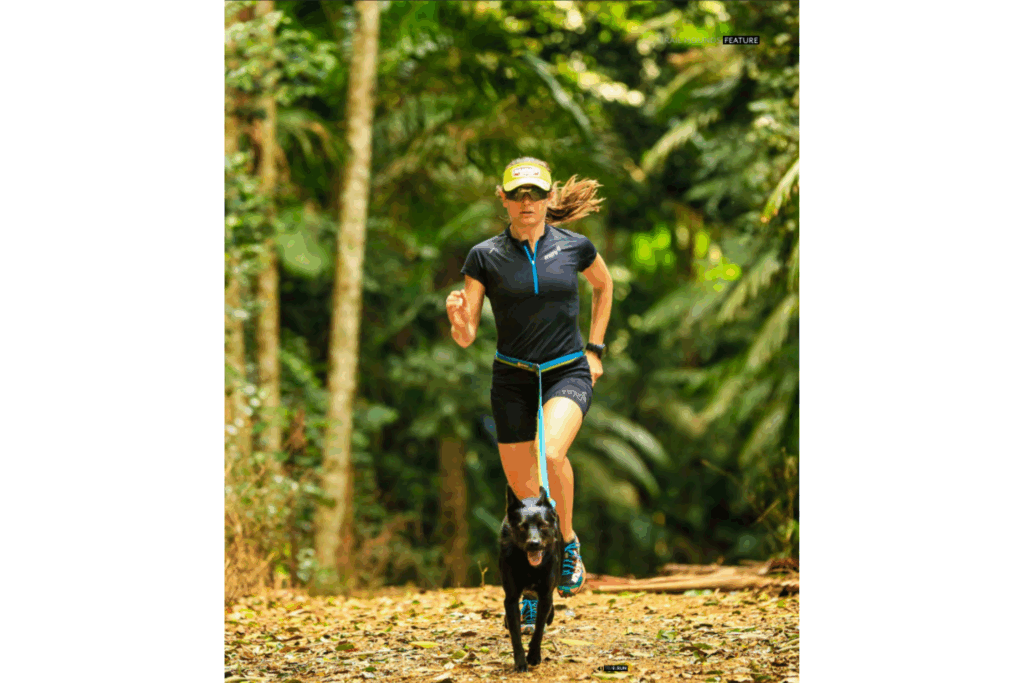
A lot of runners I know, run with dogs. Clark McClymont has Cobie the Cattle Dog.
Jono O’Loughlin has his Kelpies, Beth Cardelli has her crazy Schnauzers and I understand that over the ditch, Mal and Sally Law regularly take their Border Collie out on the mountainsides of New Zealand.
I’d always wanted a dog
I’d grown up with them but I wanted my kids to want to pick up the democratic responsibility for a dog. (Most families could commit to adoption but my husband was unconvinced).
After enough nagging I (un-democratically) tricked my husband by telling him that we were going to the cafe when in actual fact we headed to the Sutherland Animal Shelter. We soon chose and adopted Kara, who the kids renamed Bubble.
They are an extra pair of eyes and ears
I also wanted to be able to send my kids off on their own for a run with their Kelpie watching over them, instilling confidence and independence. Bubble could be my eyes and ears when I’m not there. I spent many an afternoon or early morning from the age of 10 running with my childhood mongrel, Sandy. I wanted this same freedom (and fond memories) for my girls, too.
Now she’s running, Bubble has never been healthier
When we rescued her, she was 7 kilograms of skin and bones found on the mean streets of Glebe, Sydney. Like us, the workers at the animal rescue centre saw something special in Bubble and so she managed to dodge being put down. She had to fight for every meal.
She was a master at catching the inner west Newtown pigeons out of the air in Camperdown Memorial Park. I’m guessing these flying rats often made up the main part of her diet. She was always scavenging. Maybe that’s what her endurance – which comes to light during our runs – is built upon.
But Bubble was totally malnourished when we got her, she could not walk up a hill nor match me even at my slowest. Only three inches wide at the back her hips had no muscle. Hungry, angry, frustrated and unsocialised: there was no way I could take Bubble out with me running in this condition, it would have killed her.
With time and love she became a running machine
Slowly but surely after some food, socialisation and specific training she started to ‘come good’. She soon learnt how to play with other dogs and feel confident in her surroundings. I started running and walking with her and bringing her to my Bootcamps so she could dictate the pace and the distance she was going to run and rest.
Within one month of tailored training she was running 7 kilometres at a chonky pace. Hungry kilometres and distractions disappeared as I built up her running distances slowly over time. I started to add in sprints and hill reps and she was soon whipping my butt – not to mention everyone else’s. She became one of the strongest, fittest and most eager dogs in the pack.
Bubble became the perfect running dog
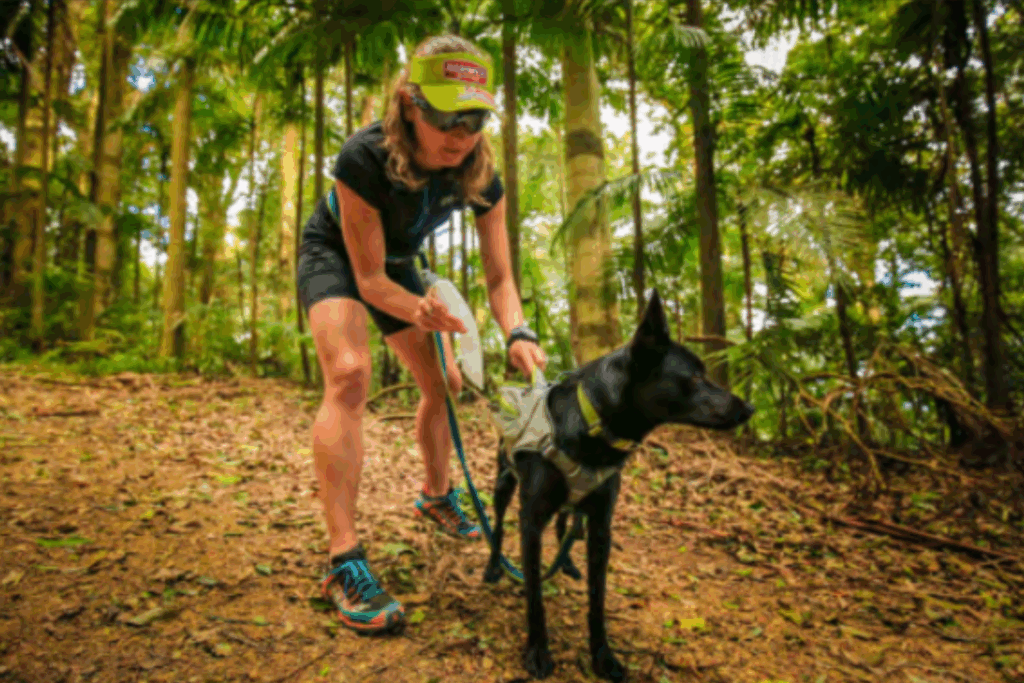
Running through the dog-friendly recreation, conservation and state parks with Bubble on the lead, I actually had to alter my running technique to reduce impact on my body. She had become so powerful running all the trails, stairs and hills with me. Our usual go-to for a dog run is Mt Coo-tha, only 16 kilometres from Brisbane’s CBD; but sometimes I’d spur of the moment go to Bubble: “Let’s go and have an adventure”. She knows instinctively that when she is up for a 30-plus kilometre run and understands that when I put a pack on, she is in for the long haul that day.
She lifts my spirits when I’m down and is always reliable
If I am running in a group she is always a great source of distraction to my mates when the full weight of the kilometres seem never-ending. She never ceases to amaze me with her speed, agility, sense of humour, stamina and Vo2 Max. She is always ready for a run and gets so excited if I have to leave for training sessions on my own, so that I don’t want to disappoint her – my right-hand dog. We are inseparable.
Looking after your dog’s health
Most of my trail running adventures are with Bubble and I find I am always a little bit more careful of her than I am of myself. Dogs can only “pant” to regulate their core temperature, so I don’t take her running on hot days, and on all runs she has regular drinks to remain cool. I always allow her to have regular dips in creeks, rivers and ponds to help her maintain optimal working temperature. She also needs to eat on the run to keep energy levels stable and prevent muscle meltdown while we tackle the challenging climbs together.
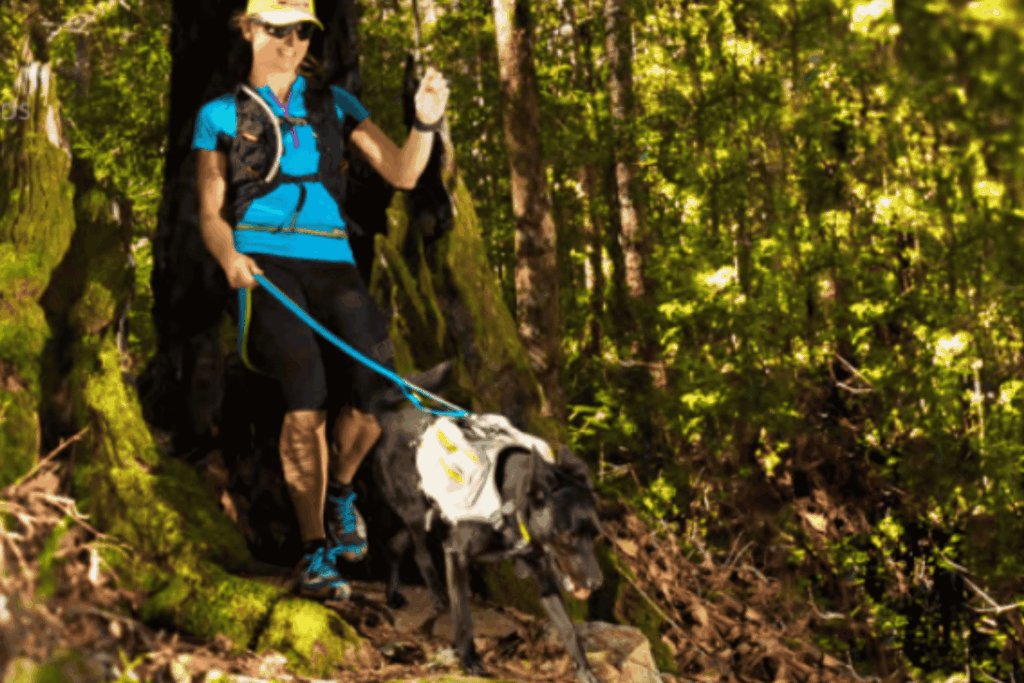
Bubble has her own hydration pack
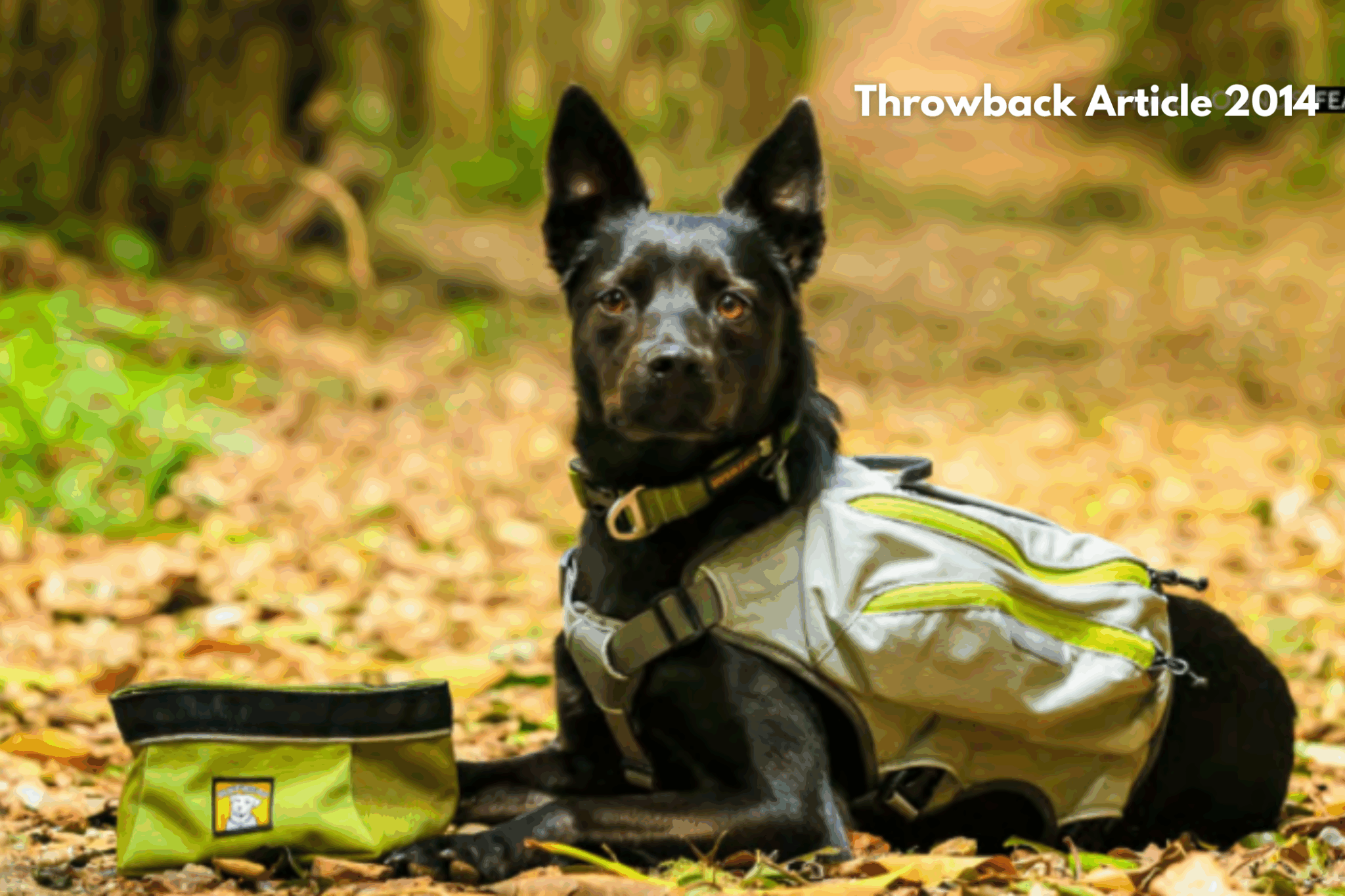
It may sound strange and we do get a lot of strange looks, but we have a Ruff Wear Single Track Ruck sack for Bubble, which is perfect for longer runs together. I can fill up her pockets with food (she likes salty potato chips on her run) and I have a collapsible water bowl and bladder for her, too. If I think she is low on water then I’ll encourage her to dip into the creek to cool down with her stomach. After particularly long runs on hot days, I give her electrolytes in cooled water, which seems to help with her stiffness the next day.
Bubble Bio
NAME: Bubble
NICKNAME: “The Bubble Factory”: she just goes and goes and goes.
BREED: Australian Black Kelpie
AGE: 2.5 years
SAVED FROM: Sutherland Animal Shelter
AGE WHEN RESCUED: 20 Months (we think) and only 8 kilograms
Current weight: 15.1 kilos
TOP SPEED: 45 km/h
Read before running with your dog
- Not all dogs can cope with running, especially long runs. Always get advice from your vet prior to including them in your running programs. Puppies should never go on runs, and all dogs are susceptible to heatstroke much quicker than humans, so never take them running in humid or warm weather
- Always provide your dog with a regular water supply, they need to drink small amounts often
- Allow your dog to cool down in streams whenever possible
- Bring high-carb treats for your dog
- Always offer your dog salty chips when next to water supply if on a long run (20+ km) to prevent cramping
- Monitor your dog’s panting rate – if they are panting rapidly find shade, water to drink, a creek or puddle to cool off in and wait until their panting rate slows to regular breathing before running again
- Always carry multiple Doggy bags to clean up after your dog
- Always discourage your dog from chasing the wildlife
- If running with your dog on a leash make sure the leash is long enough so that your dog can run directly in front of you. I’d also advise swapping hands every 500 m to prevent body imbalances. Better still, wear a dog running belt to avoid injury. The best place to absorb the impact that comes from running with your dog is through your hips and in the centre of your body. This will improve your running action by forcing correct minimal running action
- Always prepare your dog’s hydration and nutrition needs as you would your own
- Build up the kilometres slowly as you would in yourself. If you are running for more than 30 km I’d advise that foot protection is given to your dog. After Bubble’s first 50 km she had sore, cut paws. Choose trails that are soft or run just after it has rained
- Again, puppies should never go on long runs as it is bad for their developing bone structure. Only run with adult dogs and seek advice from your vet prior to starting
- Always check that dogs are allowed in the areas you intend on running
This article was written by Shona Stephenson for Trail Run Magazine issue 14 in 2014.