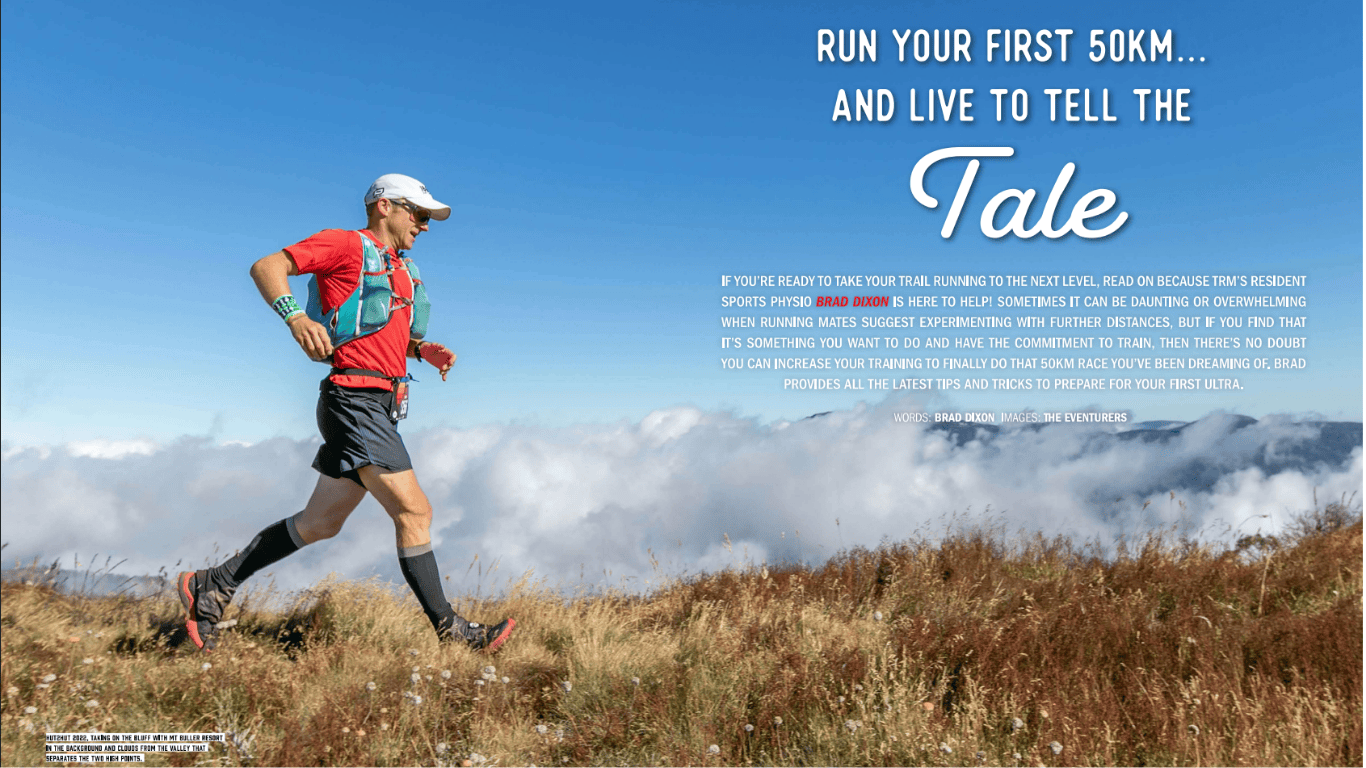
Top Tips For Running Your First Ultra
A guide for first-time ultra runners to help prepare you for your first big race. This article is from 2020, issue 46 Trail Run Magazine.
Words: Brad Dixon
Images: The Eventurers
If you’re ready to take your trail running to the next level, TRM’s resident sports physiotherapist Brad Dixon is here to help. In this article, Brad provides tested tips and tricks to help you prepare for your first ultra.
Sometimes it can be daunting or overwhelming when running mates suggest experimenting with further distances. But if it’s something you really want to do and you have the time to commit to training, then there’s no doubt you can tick off that 50km trail race you’ve been dreaming of.
From sceptic to ultra runner
Before completing my first ultra-trail run, I viewed ultra runners as ‘nutters’. I thought they were a bunch of ‘running away from life’ types with issues that needed a couch and lots of therapy.
After completing my first Tarawera Ultra 60km in 2016, running from Rotorua to the beautiful Tarawera falls in NZ, my view of the ultra running fraternity completely changed – they are the sane ones. Training and getting involved in these events is about embracing all the best aspects of life.
Experience counts — as a runner and a coach
I’ve coached trail runners for ultra distances from 50km right up to 170km. Before 2016 I competed in the odd triathlon, and I’d run road half marathons and marathons for almost 25 years.
As part of my own training, I run on trails as they’re more forgiving on the joints so good for recovery runs.
I know that endurance training is a mixture of science and art; I’ve gotten runners to the finish of their first ultra trail event with good results. In post event reviews, my trail running athletes would most often be buzzing. Full of the joys of life, and waxing lyrical about their experience. Now I understand why.
Training around life (not the other way around)
Everfit’s coaching philosophy has always been about blending in training around life so joy is enhanced.
What better way to achieve this than training with great people in our beautiful natural environment? The first major point I want to get across is your first ultra training plan doesn’t have to involve excessive running.
You don’t have to run all the time to train well
Mixing in cycling, swimming, yoga and functional body weight exercises will keep the body and mind fresh.
This more balanced approach will decrease the chance of injury and staleness.
How much running is enough in the lead-up?
I tend to use a 3–4 run a week schedule with one long slow run (my longest for my first ultra was 3hrs 10min covering 32km on similar terrain to the race), and I mixed in 2 x Les Mills RPM classes, 2 x swims and 2 x functional bodyweight exercise sessions (with a cycle or sand jog warm up/warm down of 5–10min).
Three weeks out I did 2 x 3hr runs in the space of 5 days as opposed to the usual ‘long run weekend Saturday and Sunday’.
I couldn’t do consecutive long runs due to a meniscus knee injury that flares with back-to-back runs, so I’ve learnt to train around this with spacing runs out more.
If an athlete has a history of chronic injuries that flare sometimes spacing out runs or using the bike to increase duration is a great strategy, so niggles are not aggravated.
Consistency beats perfection when running your first ultra
Getting to the start line with consistent training should be a priority with any first time ultra athlete.
Over 16 weeks you should have 4 x long trail specific runs leading into your first 50–60km ultra.
These should be completed on similar trail terrain and will build up from 20–23km for the first, followed by a 24–28km, then 28–32km and finally 32–36km for the final long run 3–4 weeks out from the race.
The other 2–3 runs in the week will be specific to the individual’s needs.
I will use a mixture of drill runs, hill reps and speed work (mainly for improving technique and the ability to get comfortable with uncomfortable) with one cruisy run.
Shoes, packs and learning the gear game
I’ve been lucky enough to coach several trail runners with experience so as a trail newbie, some of the information I required was more about the gear than the training.
Trail running shoes
After the 2015 Queenstown Marathon, I bought a pair of Hoka trail shoes and began using them on the odd run which made sure they were comfortable on my long trail runs. I was hoping to run the Tarawera in my usual Asics Kayanos, but if it was wet, I knew I would need more traction.
For most trail events, I would recommend specific trail shoes, and trialling them months before your event. Shoes make or break your event, so make sure you wear ones you know are comfortable.
I now rotate my shoes between the Hoka Cliftons (road trainers), Hoka Rincon (road racing more than 10 – 21km) and Nike Vaporflys (track and up to 10km) and the Altra Lone Peak (trail). I believe feet love a variety of shoes and it’s beneficial to have several for different training and racing requirements.
Running pack, hydration pack
I deliberated on the running pack for a while and finally settled on the Ultimate Direction Anton Krupicka. The ease of drinking and refilling the bottles swayed my decision over the pack with a bladder. This is despite having the bottles on the front taking a bit to get used to. The pack also fit my seam-sealed jacket in it, which was likely required as part of the compulsory kit.
It all comes together on the day – my experience
My first trail ultra was an incredible experience. The volunteers and the 2016 Tarawera Race Directors shaped the culture of the race so well and it delivered an experience that money could not buy.
Conditions were wet, muddy and slippery, so I was thankful for the cushioning and trail tread on the Hoka Mafate Speed but found the toe box a little narrow.
I’ll always have a pair of maximalist shoes as they were very beneficial in the wet muddy conditions over the long haul (I have used Altra shoes for the extra wide toe box in the past – and use Hoka shoes now).
The Ultimate Direction pack was fantastic with ease of taking a drink in the slippery conditions plus the speed to refill at the aid stations ensuring no time was wasted.
Another thank you to the wonderful volunteers. They calmly grabbed my bottles out of my pack as I was munching on watermelon. Seriously, isn’t the watermelon the best fruit during a trail run?. They asked what I wanted, refilled the bottles while telling me how good I looked. I know they were lying as I felt like a scarecrow in the rubbish tip. They then placed the bottles back in my pack while I grabbed chopped up banana and left.
Going into the aid stations always boosted my self-esteem and sustained me throughout the journey to the next one.
The mental ride of running your first ultra
Talking to my wife the day after my first trail race, I made the comment that an ultra run is any endurance event compressed into a day.
You have moments when you run effortlessly, feel a million dollars. Then suddenly you have to walk up rises, with your hands pushing on your knees to reduce the ache.
In those moments you start to doubt, but you keep plugging away. Before you know it, you’re cruising along feeling amazing again.
The world belongs to the person who turns up and grafts.
Why ultras change people
An ultra teaches you that if getting out and doing a little ‘grafting’ in nature was prescribed for people by our health practitioners, I truly believe we could improve the country’s health and wellbeing.
There is something very special about getting a little uncomfortable in nature.
BRAD’S TOP TIPS FOR RUNNING YOUR FIRST ULTRA
- Consider getting a coach and joining a trail running group. Having other people to take away some of the decision-making fatigue and learning from their experiences can be helpful. It can also make the training journey more joyful.
- Build up your training as you would for a marathon. Stay within your capacity and start at least 12–16 weeks before the race event.
- Your longest run can be made up of 50–70% of the ultra distance 3–4 weeks out, or a double day weekend of 60–80% of the distance cumulative over 2 consecutive day
- Build up a long run or big weekend every 4 weeks. Build distance/time over 3 weeks, followed by an absorption/easy week over trail terrain. This is better with a group of good mates.
- Train on terrain that is similar to your ultra course. This gives you confidence on the day. It also allows you to test your race equipment and nutrition, so you can make tweaks if needed.
- Add cross-training to your schedule with cycling and swimming. This boosts cardiovascular fitness, aids recovery and decreases the load on your joints.
- Full body strength training and restorative work like yoga or pilates will improve efficiency and performance. It also decreases the risk of injury, which means your training will be consistent (no injury gaps).
- Get used to your trail shoes early in your training block. Choose shoes that suit the terrain of the race you’re aiming for. Also grab an extra pair in case it’s wet or muddy. Make sure you do some training in those as well.
- Be aware of the compulsory kit leading into the event. Make sure you get yourself a race vest/pack that can hold everything that is required. Never start an event without the gear listed. You could be disqualified or you may put the potential rescue crews at risk.
- Many ultras have nutrition supplied at aid stations. Be aware of what’s supplied and train with similar fuel or carry what works for you.
- Experiment with your nutrition plan from your first week of training. Having an informed nutrition plan is pure gold leading into your first ultra.
INSIDER KNOWLEDGE: Brad Dixon is a sports physio, coach and wellness evangelist at EVERFIT Physio & Coaching. He’s written a book titled Holistic Human, and believes the power is in our daily habits. Find him at everfit.co.nz or through his socials @everfitcoach.
This article comes from Trail Run Magazine issue 46 and is available as a back issue here.