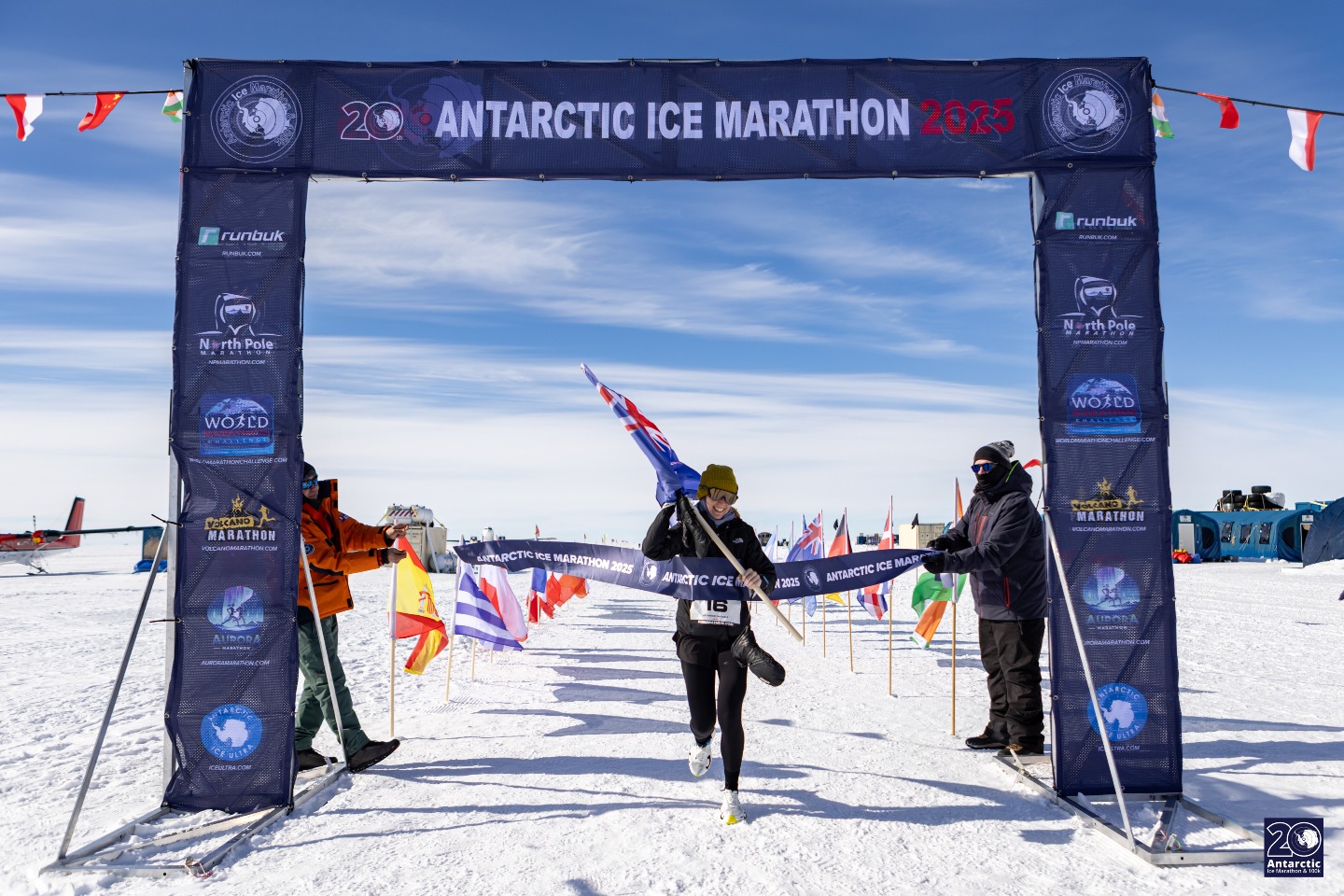
Australian runner Catherine Drysdale has etched her name into endurance running history, becoming the first woman to win the Antarctic Ice Marathon outright in the event’s 20-year history.
Drysdale crossed the line in 3:48:43, finishing more than six minutes ahead of the entire field, men and women included. The race took place on 14 December 2025 at Union Glacier, Antarctica, widely recognised as the southernmost marathon on Earth.
It’s an achievement that stands out not just because of the result, but because of where and how it was earned.
A marathon at the bottom of the world
The Antarctic Ice Marathon is unlike any other 42.2km race on the calendar. Held deep within Antarctica’s interior at Union Glacier, the course is run entirely on snow and ice, at altitude and in an environment where conditions can change rapidly.
Other articles you might enjoy
Shotover Moonlight Mountain Marathon Vertical Kilometre Race
Race-day temperatures sat well below freezing, with air temperatures under –8°C (18°F) and a “feels like” temperature close to 0°F (–18°C) when wind was factored in. Underfoot, runners face compacted snow, patches of ice, and a surface that constantly demands balance and attention.
There are no crowds lining the course, no aid stations every few kilometres, and very little margin for error. It’s a race that strips marathon running back to its most basic elements: forward motion, resilience, and problem-solving.
A race that tested everything
Drysdale’s victory wasn’t a smooth or comfortable day out by any means. Speaking to Al Jazeera English following the race, she described the experience as the toughest physical challenge she’s faced.
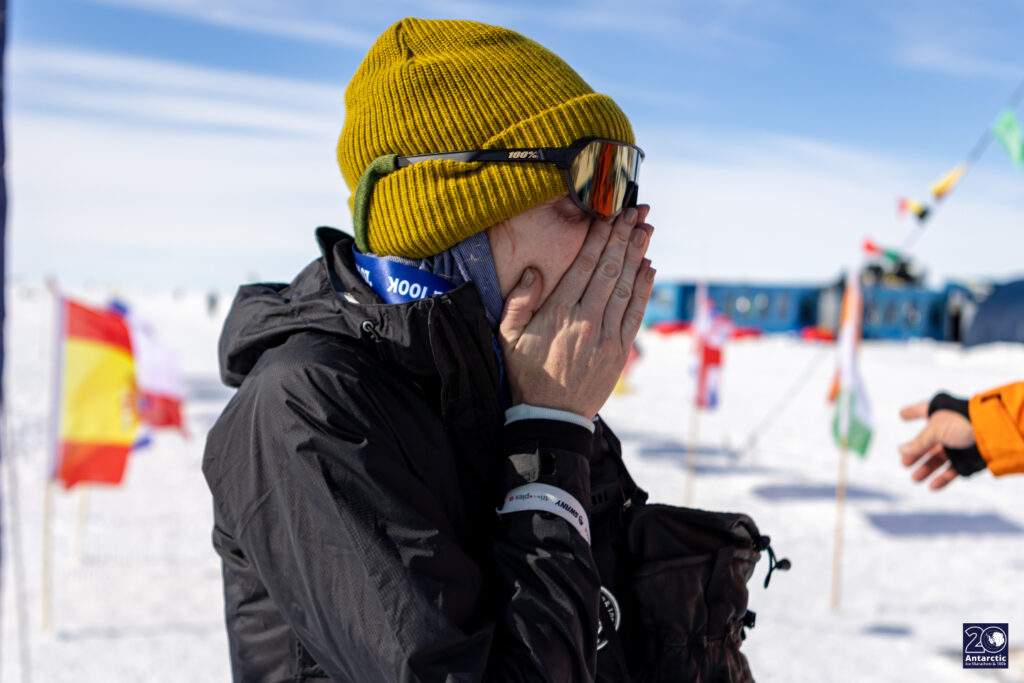
“It was without a doubt the hardest thing I’ve ever done physically. I’ve run marathons before in different conditions, but this was just something else entirely.”
She admitted the reality of the course only fully hit home during the pre-race kit check.
“The night before when we did our kit test, I thought to myself, I have completely underestimated how hard this was going to be.”
Once the race was underway, there was little respite. Every kilometre demanded attention, both physically and mentally.
“Every step of the 42.2km was tough. The conditions out here can just change so quickly and the wind picked up. Trying to manage clothing and trying to manage that mental toughness — heading into headwinds and uphill — it’s very hard to put words to how tough it really is physically and mentally.”
Despite the conditions, Drysdale steadily pulled away from the field, maintaining composure and consistency as others struggled to adapt.
Training, but not by the book
Perhaps one of the most surprising aspects of Drysdale’s win is how unstructured her preparation was. She didn’t follow a strict or highly specialised training program in the lead-up to Antarctica.
Instead, running fits into her life alongside full-time work and study.
“I work full time and do study as well, so for me running is just a way to free the mind and move the body and step away from the computer for a while.”
Her preparation mirrored that philosophy. She trained largely as she normally would, with only modest increases in distance, and later reflected that she may have underestimated the specificity required.
“Coming into it I felt a bit underprepared. If I had my time again, I would have done more running on sand and probably a little bit more intensity.”
That honesty only adds to the scale of the achievement — winning an extreme marathon in one of the harshest environments on the planet without a rigid, purpose-built training block.
More than a result
Beyond the historic nature of her win, Drysdale was quick to acknowledge the unique experience of racing in Antarctica.
“Given the opportunity, I’d absolutely do this again. It’s so tough but a completely incredible event. It’s absolutely beautiful here.”
That balance — recognising the brutality of the conditions while appreciating the environment — reflects what draws many runners to extreme events in the first place. The Antarctic Ice Marathon isn’t about fast times in ideal conditions. It’s about adapting, enduring, and seeing what’s possible when the usual comforts are removed.
A milestone moment
Drysdale’s victory marks a significant moment for the event itself, proving that the Antarctic Ice Marathon is no longer defined by historical patterns or expectations. It also stands as a reminder that endurance running achievements don’t always come from perfect preparation or textbook training plans.
Sometimes, they come from showing up, problem-solving in real time, and refusing to let the conditions dictate the outcome.
At the bottom of the world, Catherine Drysdale did exactly that — and rewrote the history books in the process.
Credits
Quotes sourced from Al Jazeera English Instagram interview with Catherine Drysdale.
This is one of our digital-only stories. If you enjoyed it, stick around — new online articles land weekly.