Unless you’ve been hibernating for the past few weeks, you’ll know that Australia is in the grip of some fairly extreme summer conditions. Heatwaves are rolling across Queensland, New South Wales, Victoria and South Australia and stopping many of us in our tracks. For trail runners, that means confronting a familiar question: should I run today… and will I fall in a sweaty heap on the dirt?
When temperatures soar like they have been lately, we need to train a bit differently (or take a raincheck) rather than just toughing it out. But first, let’s talk about humidity.
Why humidity can be dangerous
Most of us instinctively understand that running in high temperatures is harder on our body. That seems obvious. But what’s less understood by runners is the impact of humidity — that moist oppressive heat we all love to hate.
We normally cool ourselves down through sweating. As sweat evaporates off our skin, it removes heat and lowers our core temperature. But in humid conditions, the air is already saturated with moisture, which makes evaporation less effective. The result? Our internal temperature rises and our heart rate climbs. In other words, high humidity dramatically reduces our body’s ability to cool ourselves down and regulate our temperature.

According to research published in the Journal of Sports Sciences and guidance from the Australian Institute of Sport (AIS), we also run a far higher risk of heat exhaustion and heat illness, even at moderate temperatures when humidity is high.
In practical terms, a humid 28°C run can feel suffocating and much harder than a dry 36°C run.
Unfortunately for trail runners, humidity is often amplified by the locations where we run:
- Dense forest and rainforest environments
- Still air in gullies and sheltered valleys
- Coastal conditions
- Early morning moisture trapped beneath forest canopy
This is why we feel completely wrecked on days that don’t even look extreme on the weather app.
Why your run feels so much harder in extreme heat
It’s not in your imagination that when temperatures soar your body slows down and effort seems herculean. As our heart rate climbs, our core temperature rises and blood flow is diverted toward the skin to help with cooling. This reduces the amount of oxygen available to working muscles. The result is fatigue and our perceived effort skyrockets.
This is also backed by science. Studies published in Sports Medicine show that endurance performance can decline by 10–30% in hot conditions — even in trained athletes.
So let’s not beat up on ourselves for going less than full gas during heatwaves. Our bodies are physically struggling. This isn’t weakness. It’s biology.

The best (and worst) times to run during a heatwave
Runners are generally aware of this, but when it comes to heat management, timing is everything.
Early morning is usually the safest window, which is why we see so many of our kind out and about around dawn. Air temperature is cooled overnight so trail surface temperatures and humidity levels drop which feels tolerable. But importantly, it gives our body the best chance to regulate heat.
Late afternoon and early evening, however, can be deceptive. Even if air temperatures start to drop, the ground continues to radiate stored heat. Especially fire trails, rock slabs and exposed ridgelines. Add lingering humidity, and these sessions can feel brutal.
For trail runners, terrain matters too:
- Fire roads retain heat longer than shaded singletrack
- Exposed ridges amplify sun load
- Dense forest traps humidity
- Coastal trails often remain sticky well into the evening
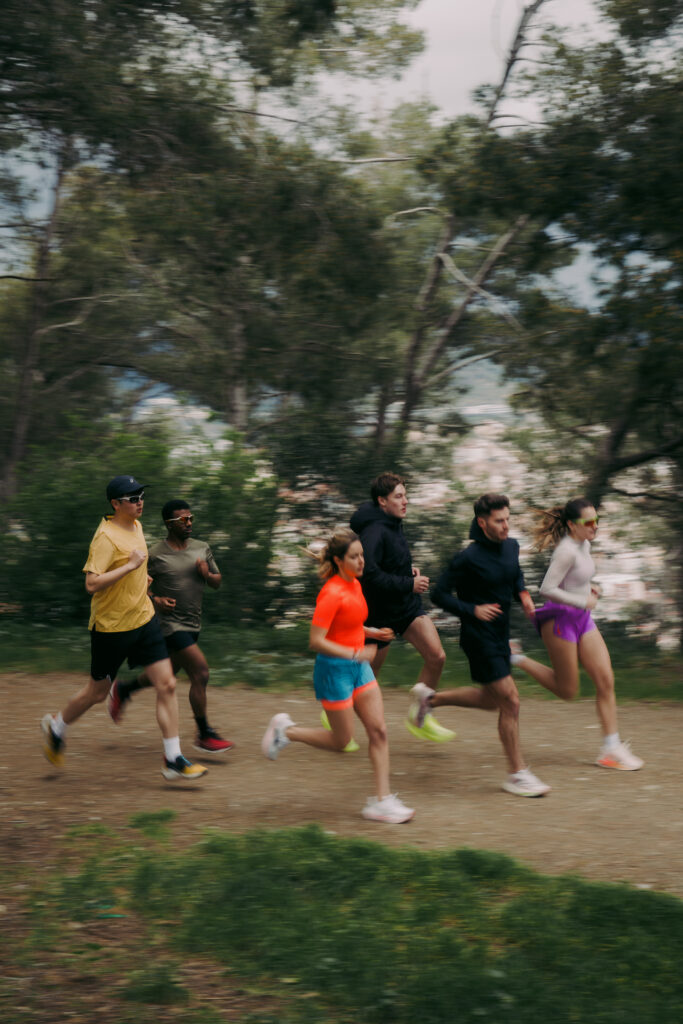
If you’re choosing a time to run during a heatwave, aim for:
- Sunrise starts
- Shaded routes
- Flowing singletrack rather than open fire trails
- Higher elevation where possible
And be prepared to shorten your run if conditions escalate.
When not to run (and what to do instead)
Some days, the smartest decision is not to run at all.
According to Sports Medicine Australia and the AIS, running should be avoided when:
- Temperatures exceed 35°C
- High humidity pushes the apparent temperature into extreme zones
- Fire danger ratings are elevated
- Air quality is compromised
On these days, consider:
- Strength sessions
- Mobility and recovery work
- Easy treadmill runs in climate-controlled spaces
- Early morning walk-runs
- Cycling or swimming
Consistency over time beats any single heroic workout. Check out Sports Medicine Australia’s Extreme Heat and Response Guidelines for further information.
10 Tips for Running During a Heatwave
Running through summer doesn’t have to mean suffering through it. A few adjustments can dramatically improve safety, comfort and performance. But know the signs of heat stroke and exhaustion and stay vigilant to your own body’s signals. Consider seeing a health professional for tailored advice.
1. Run by effort, not pace
Forget splits. Use breathing, heart rate, or perceived exertion as your guide.
2. Start earlier than you think you need to
Dawn runs are a better choice during heatwaves.
3. Choose shade over vert
Climbing in direct sun spikes heart rate and heat load which increases the risk of heat stroke and exhaustion.
4. Shorten runs, increase frequency
Two shorter sessions often beat one long sufferfest.
5. Hydrate before you start and during
Pre-hydration significantly improves thermal regulation.
6. Use ice and cooling strategies
Frozen flasks, ice in hats, cold towels and neck wraps all help.
7. Wear light colours and breathable fabrics
Dark kits absorb heat. Ventilation matters.
8. Avoid exposed fire roads
Singletrack through trees stays cooler far longer.
9. Know your bail-out points
Plan exits, water stops and shade zones before heading out. And stop regularly to allow your body to cool.
10. Be willing to turn around early
It’s not a fail to exit early. If you feel the signs your body is not coping stop and run another day.
The long story short
Heatwaves demand respect. Understanding how our bodies respond in extreme heat helps us train smarter, stay safer, and keep enjoying summer running.
And sometimes it might just be too hot to run. The trails will be there tomorrow.
We’re not doctors or medical professionals. For this piece, we leaned on credible Australian and international sports science sources to pull together practical advice. But nothing beats talking to a medical health professional about your own circumstances.
References
Australian Institute of Sport — Beat the Heat Guidelines
Sports Medicine Australia — Heat Illness & Exercise
Journal of Sports Sciences — Thermoregulation and endurance performance
American College of Sports Medicine — Exercise in the Heat Position Stand